
What do a three-thousand-year-old African folktale, Jonathan Swift’s Gulliver’s Travels (1726), and the price of your next computer have in common? Hard to say, at first glance. And yet, as Dirk Gently, holistic detective, would put it: “Everything is connected!”
I started pulling on this thread after playing a video game that left me with a strange feeling.
Eliza
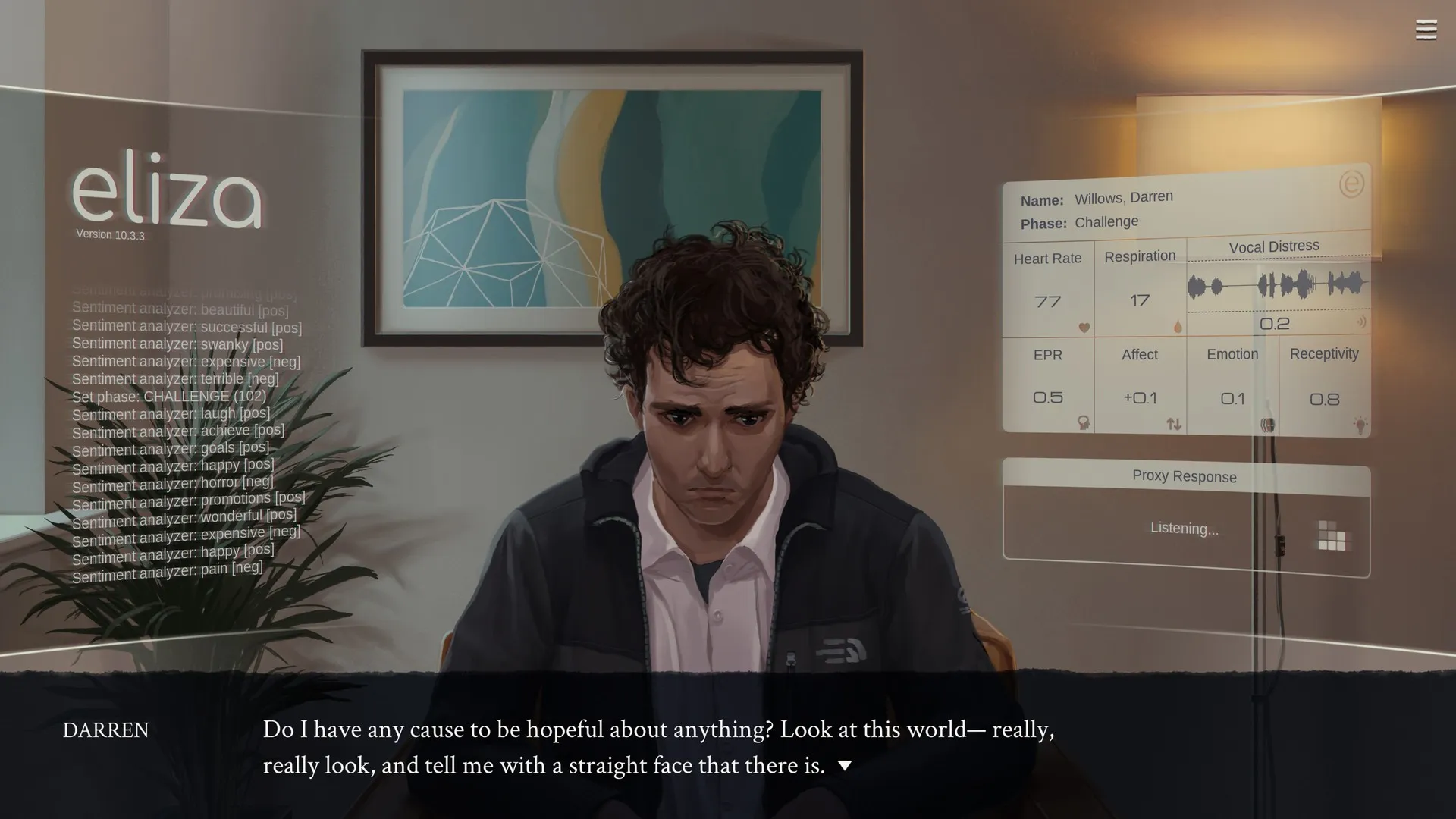
Eliza (a 2019 game by Zachtronics) puts you in the shoes of Evelyn, a young woman who helped build a therapeutic AI. After a burnout that kept her away from the tech world for several years, she returns to work, not as a developer, but as a proxy. Her job is to read aloud, face to face with real patients, the lines that Eliza, the AI therapist, feeds her through the display in her smart glasses.
Seeing from the other side what her creation has become, she begins to wonder whether she did the right thing.
I’ve worked in tech for nearly twenty years. I recognized myself in Evelyn in more ways than one, and at first, I preferred not to look too closely at which ones.
There’s the question I come back to regularly: what kind of future are we actually building through our technological innovations? I remember a family day out, following a treasure hunt printed on a sheet of paper through a town in the Cantal (middle of France). I realized, that afternoon, that I was having more fun than I’d had with most of the tour guide mobile apps I’d used, including ones I’d designed myself.
With AI, we now have technology that could free us from the most tedious and repetitive tasks. Instead, we lead with the generation of mediocre illustrations, books without authors, music without musicians. We hand the machines what makes us human, while leaving intact the drudgery that robs us of the very space we need to express ourselves through creation.
Then there’s the other side of it: millions of people today confide their most intimate anxieties to large language models (LLMs), simply because they have no one else to talk to. Some find a form of comfort there, many develop emotional dependencies, and for a few, it ends badly. We have never been more connected, and never felt quite so alone. Having gone through therapy myself, I know that a safe space for being heard is not this.
I initially assumed this situation was new, something that arrived with ChatGPT, then Claude, Gemini, and the rest. But trying to understand it, I came to see that it had been predicted far earlier. Intuitions spanning centuries, left here and there by people who had neither computers nor language models, but who had already sensed that something was coming. That’s the story I want to trace here, because I think it tells us something important about what’s happening to us.
ELIZA
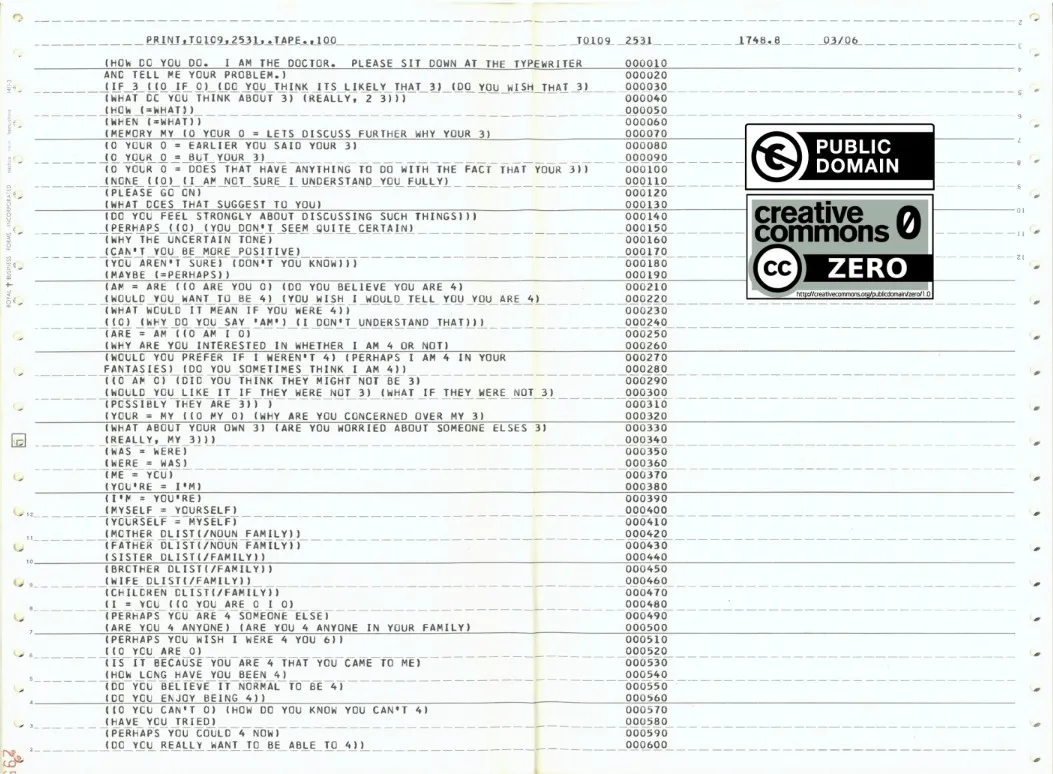
In looking up the game Eliza, I learned that it had been named after ELIZA, a computer program designed in 1966 by Joseph Weizenbaum, a German-American computer scientist. It was one of the first conversational agents, built to simulate a session with a psychotherapist, and intended to study the patterns of communication between humans and machines.
To work around the technical limitations of the time — and avoid having to embed a huge database of real-world information into the program — Weizenbaum used an ingenious keyword recognition system, with words classified by type and importance, and a decision script called DOCTOR that determined how to respond. For this, he created a purpose-built programming language suited for text processing, called Michigan Algorithm Decoder Symmetric List Processor (MAD-SLIP), along with a method of substitution that gave users the illusion of natural language comprehension.
The program was so convincing that, much to Weizenbaum’s surprise, many users — his secretary being the first — developed an emotional dependency on it. So much so that the tendency to attribute understanding to a machine that cannot possibly have any became known as the ELIZA effect.
Of course, the program couldn’t actually understand anything. It simply kept the user talking, cleverly reflecting their own sentences back as questions, nudging them to continue. It’s worth remembering the context: at the time, the personal computer didn’t exist. For early users, speaking with a machine still carried something magical about it, and despite Weizenbaum’s repeated objections, they were convinced they were encountering something like intelligence and understanding.
When the software couldn’t match anything in its instructions to what the user had written, and didn’t know how to interpret it, the default response was: “I see…” or “I understand…” What might have been a weakness in the program turned out to be an unexpected strength. Some people discovered that they didn’t need a real answer — they needed to be heard without judgment. The illusion became real in the very act of speaking.
Alan
This experience — talking naturally with a machine and being convinced it was a person on the other end — connects directly to Alan Turing’s work on artificial intelligence from as early as 1950. He described, in the form of a test (the Turing Test, originally called the Imitation Game), a machine’s capacity to fool a human into misjudging its nature.
Turing, a British mathematician, played a decisive role in breaking German communications during the Second World War. He is now widely regarded as the father of computing and a pioneer of artificial intelligence. He predicted that by the year 2000, it would be possible to program computers with around 128 megabytes of memory and have them play the Imitation Game well enough that an average user would have no more than a 70% chance of correctly identifying them after five minutes of questions. His prediction about memory capacities proved remarkably accurate, but the Turing Test remained undefeated far longer than he’d expected.
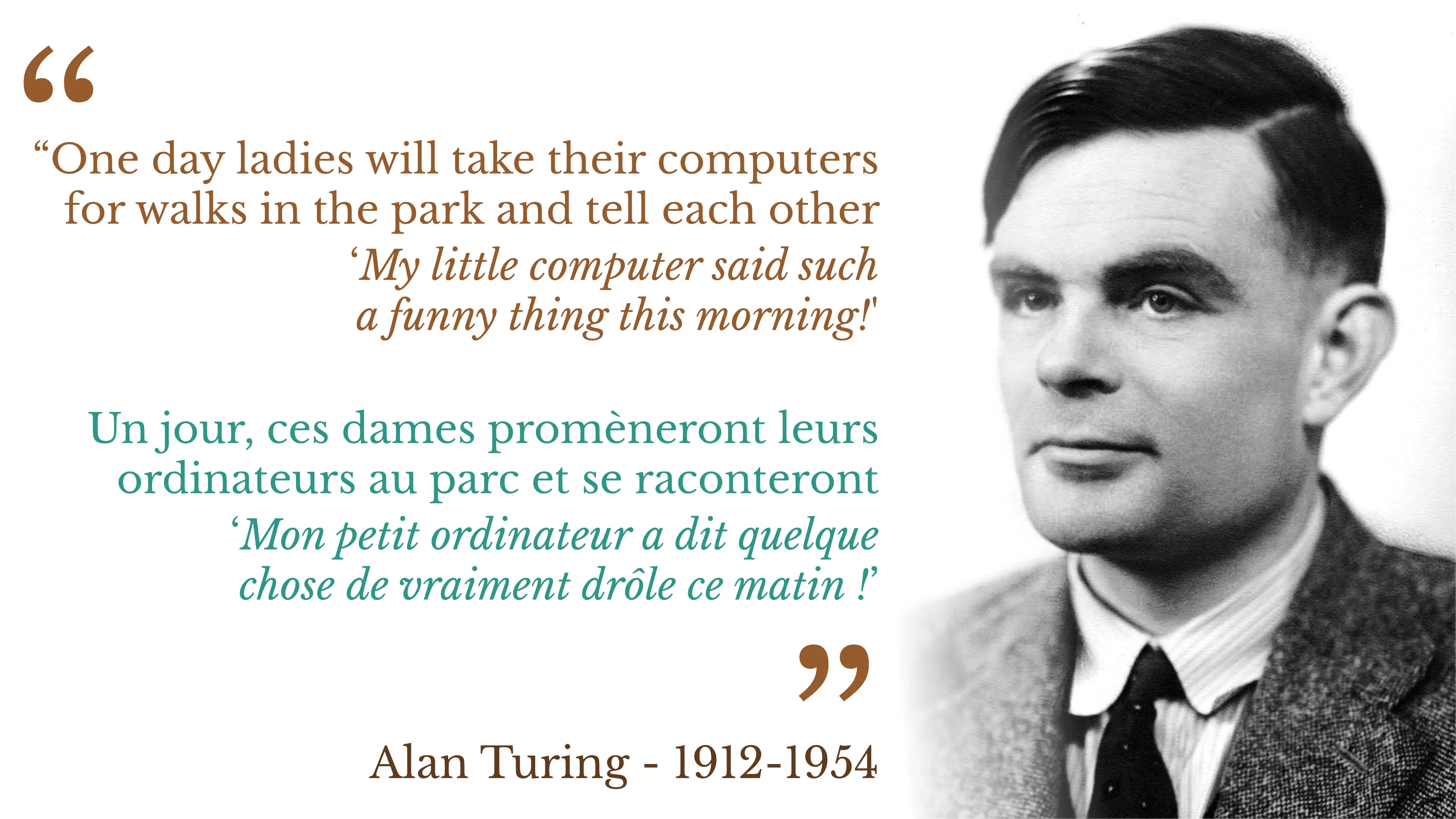
Passing it remained a secondary scientific goal for quite some time, for good reason: it doesn’t measure intelligence or consciousness — only imitation. Is the ability to pass as human through language really enough to call a machine intelligent? We recognize sophisticated intelligence in certain animals without needing to communicate with them in language. Turing is nevertheless an iconic figure for those who believe in artificial intelligence, not least because of his disarmingly optimistic vision of what was coming: “One day, ladies will take their computers for walks in the park and tell each other: ‘My little computer said such a funny thing this morning!’”
If the year 2000 fell short of Turing’s full vision, it still had its landmarks. In 1997, IBM’s Deep Blue supercomputer beat Garry Kasparov at chess for the first time, deploying enormous computing power — evaluating 200 million moves per second — to pick the best move at every turn, drawing from a database compiled from decades of professional games. It would take until 2016 for Google DeepMind to beat a Go player (considered an even greater challenge than chess), using machine learning and artificial neural networks to develop its own internal logic.
The progress in the last five years has been so rapid that it nearly eclipses all the advances in machine intelligence made since ELIZA in 1966. In 2023, the journal Nature reported that ChatGPT-4 had become the first program to defeat the Turing Test, deceiving 41% of testers — far ahead of GPT-3.5, which had managed only 14%. Stanford researchers confirmed the result in a study in early 2024. Then, barely a year later, researchers at the University of San Diego organized a five-minute test in which participants conversed simultaneously with two interlocutors. After speaking with both a human and ChatGPT-4.5, 73% of participants identified ChatGPT-4.5 as the human. In that same test, ELIZA — the program from 1966 — still managed to fool 23% of participants. Not bad for something sixty years old.
The trajectory of recent years is vertiginous. We have crossed the point where the illusion is no longer distinguishable from reality. Machines now speak our language, write it, and generate images and sounds whose authenticity can no longer be asserted with any certainty. But is this achievement really the product of a single century’s obsession?
Ada
To find out, let’s go further back — before the conversational agents of the 1960s, before the invention of the transistor that made the first electronic computer possible in 1947, before their predecessors the vacuum-tube and electromechanical computers — and stop at the very dawning of electrical mastery, in 1842, in a village in the south of England.
Ada Lovelace, Countess of Lovelace, born Ada Byron in London in 1815, was the daughter of a poet and a mother with a passion for mathematics, and was raised primarily by her grandmother. Under her mother’s influence, she received a thorough education in mathematics and science — highly unusual for a young noblewoman of the time. Her interests were remarkably wide-ranging, from mechanics to what she called poetical science, including the idea of modelling thoughts and sensations mathematically. As she grew up, her tutor, the scientist Mary Somerville, brought her into contact with many of the era’s leading figures: scientists such as Andrew Crosse, Charles Wheatstone, and Michael Faraday, as well as the author Charles Dickens. In 1833, she met Charles Babbage, a mathematician and visionary inventor in whom she seems to have found something of a father figure.
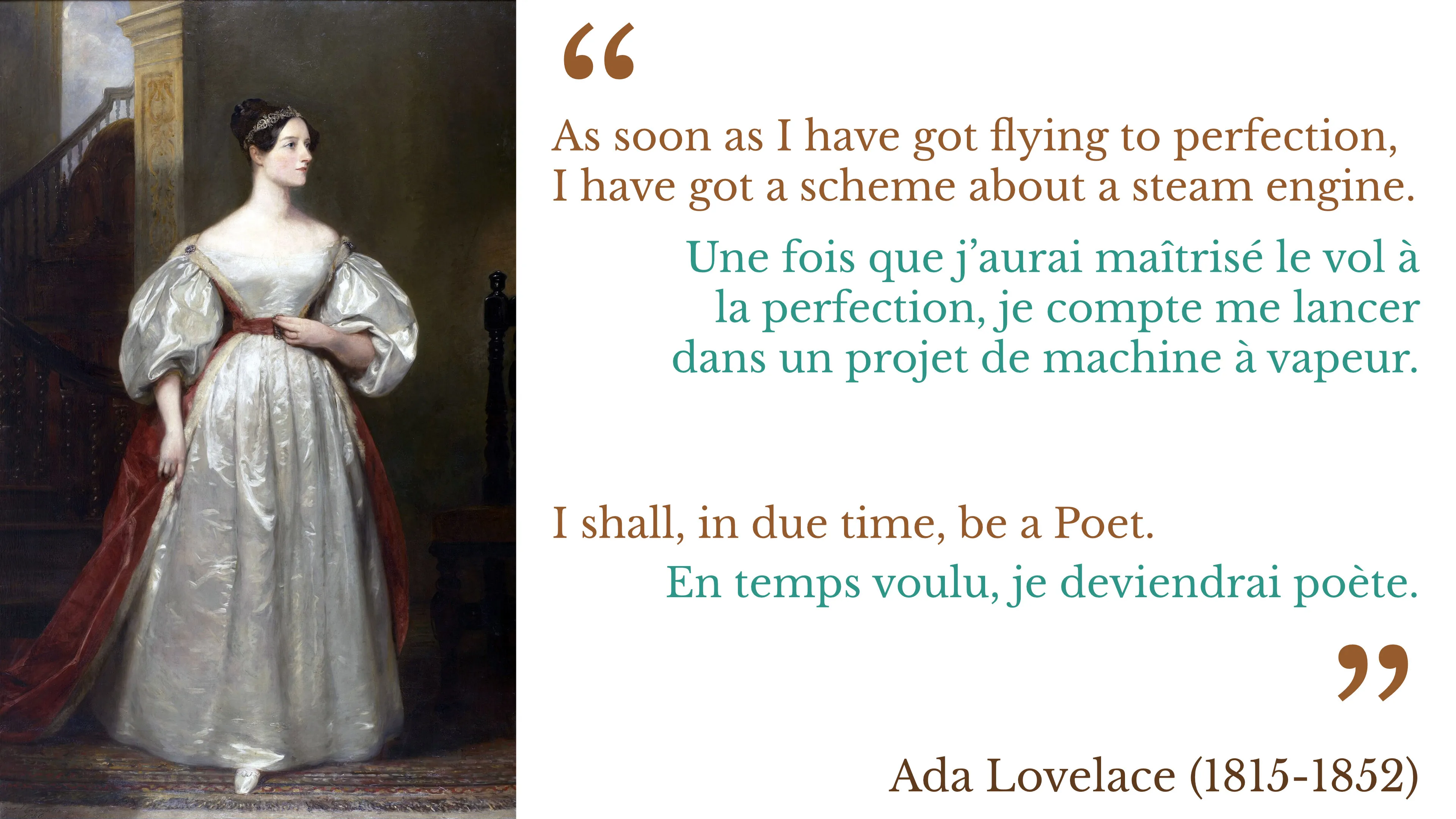
Babbage was then at work on a new kind of calculating machine, incorporating automation into a difference engine (an entirely mechanical device designed to compute tables of polynomial functions). He drew on a concept developed at the very start of that century by a French inventor: the Jacquard loom — the first mechanically programmable system — which made weaving looms configurable by the operator. A sequence of instructions punched into paper cards allowed the machine to read and interpret commands, converting them mechanically into patterns on a piece of cloth. Babbage wanted to adapt this invention to give a calculating machine similar capabilities. He never had the chance to build his analytical engine, but devoted his life to designing it in the finest detail.
The Analytical Engine weaves algebraic patterns just as the Jacquard loom weaves flowers and leaves.
In 1842, Ada took an interest in Babbage’s machine and offered her help in developing and promoting it. To get to grips with how it worked, and while Babbage was unwell, she was asked to translate into English a French transcript of the lecture Babbage had given in Turin some years earlier, which had recently been published. Babbage asked her to enrich the translation with any notes she thought useful, commenting on and elaborating certain aspects of the paper. She then threw herself into an intense period of work that resulted in seven notes, labelled A through G, amounting to nearly three times the length of the original article. The annotated translation was published in 1843 and met with real success — the work was precise and thorough, and it made the usefulness of the analytical engine impossible to deny. Something Babbage had never quite managed on his own.
Ada Lovelace’s notes have since become legendary in the history of computing, and Note G in particular — which describes a detailed algorithm for calculating the Bernoulli numbers (a sequence of rational numbers) using the analytical engine. That algorithm is often considered the first published computer program in history, written a full century before the first computer was built, and never once tested (Babbage never found the funding to have his machine constructed). Ada thus became the first programmer in history, and invented in that first program the first conditional loop — the while X is true, do Y — which has been a cornerstone of computing ever since.
Some have questioned Ada Lovelace’s status as the first programmer, arguing that notes Babbage had written before her publication already contained early sketches of programs for the machine. But those were never published, and specialists concede they did not reach the sophistication or elegance of Ada’s work. Whatever way one tells this story, the mathematician’s notes undeniably place her as the first to imagine applications for this programmable calculating machine that reached far beyond mathematics.
The engine might act upon other things besides number […] Supposing, for instance, that the fundamental relations of pitched sounds in the science of harmony and of musical composition were susceptible of such expression and adaptations: the engine might compose elaborate and scientific pieces of music of any degree of complexity or extent.
Yes, you read that right. At a time when the invention of photography was upending the way people represented the world, when steam engines were driving industry toward revolution, and when the most futuristic object around was the telegraph, Ada was inventing the concept of electronic music… while watching a loom.
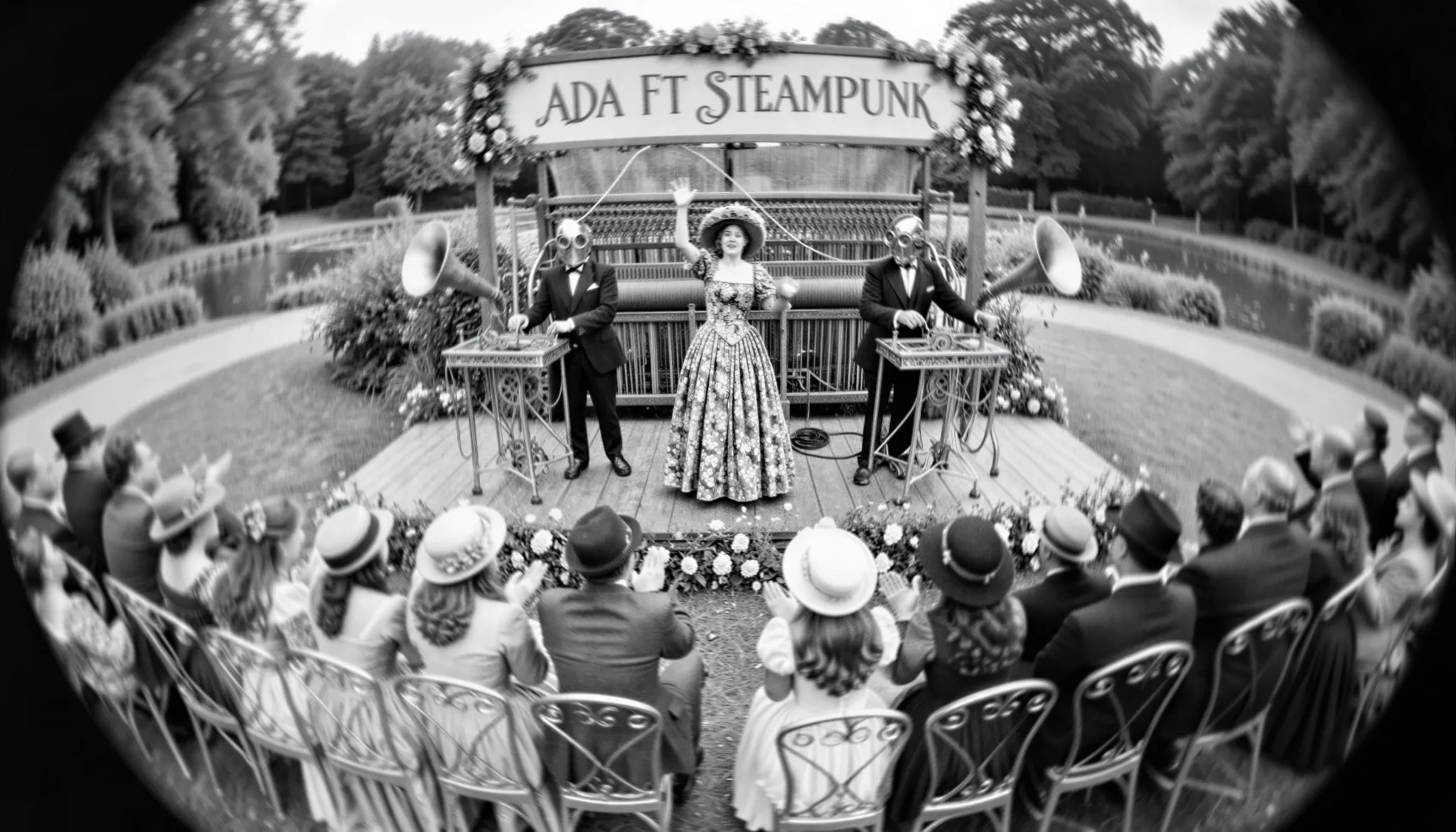
Ada Lovelace was deeply interested in how the brain works, and as early as 1844 she expressed her wish to create a mathematical model explaining how the brain produces thoughts and how the nerves give rise to sensations — a mathematical model of the mind. Note G also contains a warning: the analytical engine does not constitute artificial intelligence.
The Analytical Engine has no pretensions whatever to originate anything. It can do whatever we know how to order it to perform. It can follow analysis; but it has no power of initiating anything.
This passage was later addressed by Alan Turing in 1950, who interpreted it to mean that “computers cannot surprise us” — to which he replied that, on the contrary, they can surprise us very much, particularly when the consequences of certain inputs are not immediately perceptible. He attributed Lovelace’s view to the scientific context in which she was writing, and argued that, in the light of more recent knowledge, the brain’s storage mechanisms appear to share meaningful similarities with those of a computer.
This resemblance between human and machine, between thought and computation, is evoked by two scientists separated by a century. And it doesn’t stand alone: one might also connect it to the philosophers of the eighteenth century, among them Descartes, who compared the human body to the mechanisms of a clock — a formulation Rousseau reworked as:
I see in any animal only an ingenious machine, to which nature has given senses to wind itself up and protect itself.
And they were far from the only ones to grapple with the question of the human-machine, or of artificial intelligence.
Jonathan
The eighteenth century was pulled in two directions. On one side, the enthusiasm generated by the discoveries of the previous century — Newton, Galileo, Kepler — had fundamentally changed the way people understood the world, and with it came a surge in experimental science, physics, astronomy, medicine, and a taste for scientific curiosities and sometimes absurd technical projects. On the other, older beliefs persisted, science was sometimes applied naively, and a certain skepticism lingered about the benefits of scientific reason for humanity.
It was in this climate that Jonathan Swift — writer, Anglo-Irish clergyman, and above all satirist and political pamphleteer — wrote Gulliver’s Travels, published in 1726. This pastiche of the travel narratives so popular at the time, sometimes shelved in children’s literature, is in reality a political pamphlet, a fierce satire of scientific progress, and a philosophical fable about the human condition.
The Royal Society of London for Improving Natural Knowledge — founded in 1660 — is mercilessly mocked by Swift in two chapters set on the flying island of Laputa, where eccentric characters multiply and grotesque research abounds (extracting sunbeams from cucumbers, softening marble to make pillows, and so on). The island’s inhabitants are obsessed with astronomy, mathematics, and physics. They spend entire days thinking and rethinking things, making conjectures and endless calculations, to the point of losing all common sense.
On this island, Gulliver meets a researcher who shows him a remarkable machine. Roughly seven metres on each side, it is made up of small wooden pieces the size of dice, linked together by metal wires, with small paper slips glued to each face. On these slips are written all the words of the language, in their various tenses, moods, and declensions, but in no particular order. Around the perimeter of the machine are forty handles; when turned, they rotate the wooden pieces, rearranging the words. The master then asks his students to read quietly the lines that appear on the machine, and whenever three or four consecutive words look as though they might form part of a sentence, they note it down. The class repeats this tirelessly, for several hours a day. The professor shows Gulliver several large volumes of disconnected sentences, from which he hopes to extract a complete body of knowledge across all the sciences and arts.
Every one knew how laborious the usual method is of attaining to arts and sciences; whereas by his contrivance, the most ignorant person at a reasonable charge, and with a little bodily labour, might write books in philosophy, poetry, politics, law, mathematics, and theology, without the least assistance from genius or study.
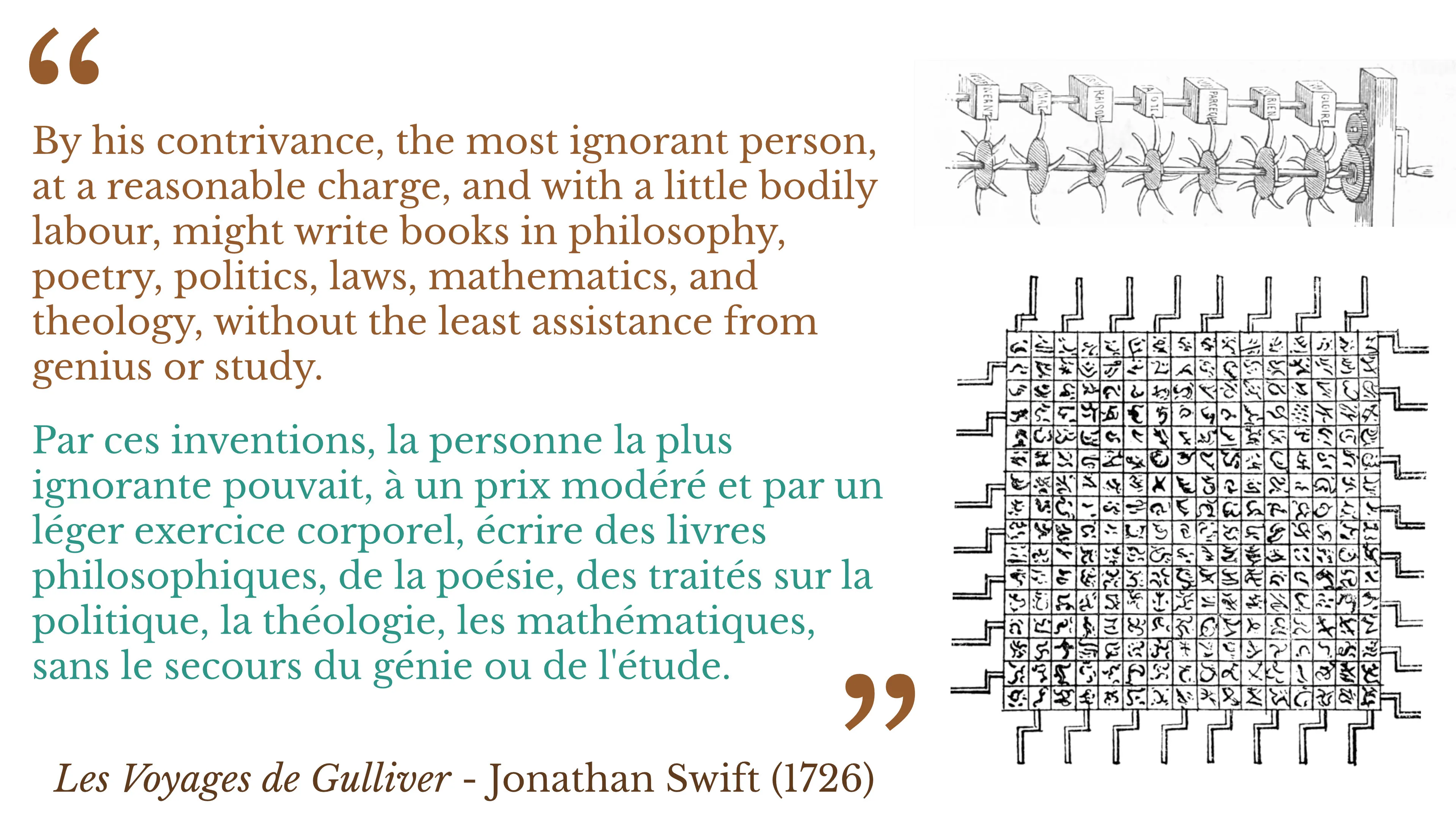
Swift, a master of the absurd, was of course trying to provoke his reader, to ridicule the inventions of the time and the scientific excesses they bred. But that doesn’t change the fact that what he describes is, neither more nor less, ChatGPT. A large language model works by assembling fragments of words, finding the most probable combinations based on its training — which consists of breaking down the millions of texts produced by humans (or other computers). An LLM does not really understand what it writes in the way a human does; the machine does not attach meaning to the words it assembles. It excels at forming and stringing together sentences by imitating us.
Before leaving Gulliver’s Travels, one other passage is worth noting. When the King of Brobdingnag — an island of giants — encounters Gulliver, who appears tiny by his standards, he cannot for a moment conceive that this creature might be human.
He concluded I might be a piece of clock-work… contrived by some ingenious artist. But when he heard my voice, and found what I delivered to be regular and rational, he could not conceal his astonishment.
We have pulled a thread that connects the LLMs of our present to this time capsule from exactly three hundred years ago. A thread woven from the silk of the Turing Test, which illuminates an obsession as old as language itself: the dream of a machine that, if it cannot think, can at least speak as we do.
One could go on at length, because the question of artificial intelligence — in one form or another — has surfaced throughout human history. From Mary Shelley’s Frankenstein in the nineteenth century to the mechanical automata that fascinated the eighteenth, from the legends of the Middle Ages to the founding narratives of our various religions: every era has seen people’s imagination working at full tilt, searching for ways to create an equal by artificial means. Is it a way of filling some form of loneliness? Of leaving a trace of our existence, and so defeating our mortality? Or simply a consequence of our cognitive capacities — a side effect of the evolutionary advantage that allows us to transform our environment, to build, transmit, create, seduce, and cooperate?
If one wants to find the very beginning of the thread, the first stirring of this desire to create the living by our own hands, you can trace it back to the Greek myth of Pygmalion, the sculptor who brings his statue to life with Aphrodite’s help. But that myth is now thought to have its own origins in an African legend three thousand years old. And what to make of the forty-five million cave paintings and rock carvings representing humans and their environment, left by peoples who preceded us by tens of thousands of years? Did they come alive in the light of a flame, allowing the earliest humans to tell their stories, to feel a little less alone, to leave their mark?
Did you know? The ELIZA conversational program from 1966, which we met at the start of this story, takes its name from the character of Eliza Doolittle — the protagonist of George Bernard Shaw’s 1913 stage adaptation of Pygmalion.

Claude
Back to the present, and back to the riddle that opened this piece. What does any of this have to do with the price of computer memory in 2026?
Well: the 1966 ELIZA program, at 420 lines of code, required the equivalent of around a hundred kilobytes of RAM to run — roughly the amount of data contained in a four-page text-only PDF.
Today, it is possible to run a language model on your own computer — the kind you can have a conversation with, or use to generate images, sounds, and music — without sending anything to a remote server (private, local, free, and far less energy-hungry than the cloud versions). To do so, you need a piece of hardware called a graphics card, equipped with a large amount of memory. These are the same cards used to play video games, translating lines of code into images in real time. The problem: after the shortages caused by cryptocurrency miners in 2020, it is now the AI giants who are hoarding the lion’s share of these memory chips, which has sent prices soaring — sometimes multiplied fivefold over the course of 2025 alone.
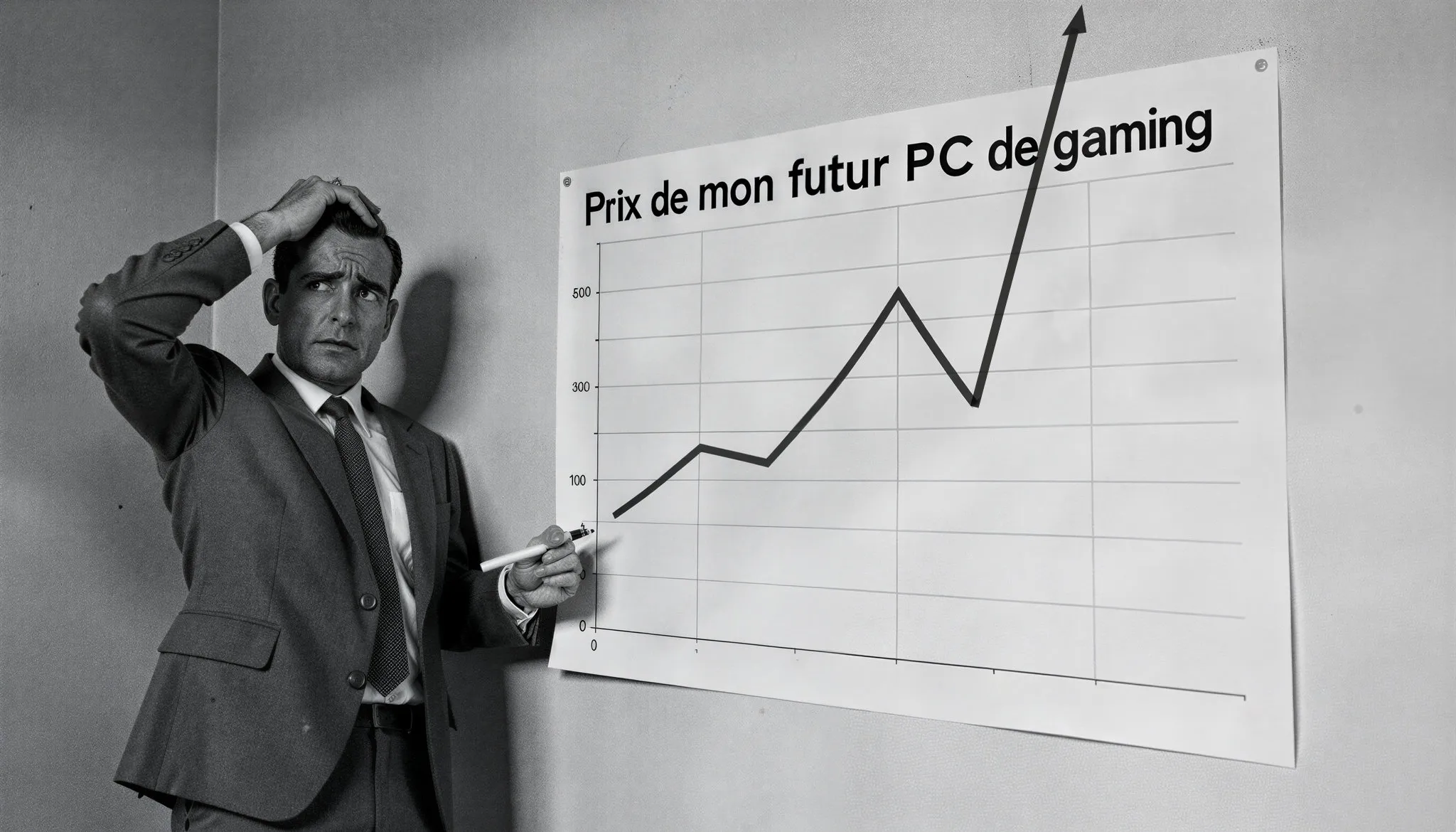
To run a local AI model, you need at least 24 gigabytes of RAM. That’s roughly 200,000 times more than the 1966 ELIZA program required. For the AI systems we use online, the numbers aren’t public, but current estimates suggest that models like Gemini, Claude, ChatGPT, or France’s own Le Chat from Mistral AI might require something in the order of 10 terabytes of memory to operate — equivalent to more than 400 gaming PCs running simultaneously just for you, 80,000 times more than Turing predicted for the year 2000, and ten billion times more memory than ELIZA needed to pass for a human. Staggering.
Conclusion
What I recognize in Evelyn, the protagonist of Eliza, is a posture I know well: that of someone who helped build something, and who one day finds themselves wondering what it has actually produced. It’s not about regret, or deconstruction. It’s about facing the question that presents itself, the one you can no longer pretend not to hear.
Throughout history, people have sought to create artificial versions of themselves — whether in marble, in metal gears, or in lines of code — and the question has always been the same: why? Now that machines can communicate with us in ways indistinguishable from another human being, what do we choose to entrust to them? Creating, feeling, loving — precisely what makes us human? Or instead, the tedious and painful tasks that rob us of the space we need to feel alive?
The machine is learning to speak to us. Meanwhile: who are we speaking to?
The attempt to make a thinking machine will help us find out what we think ourselves.
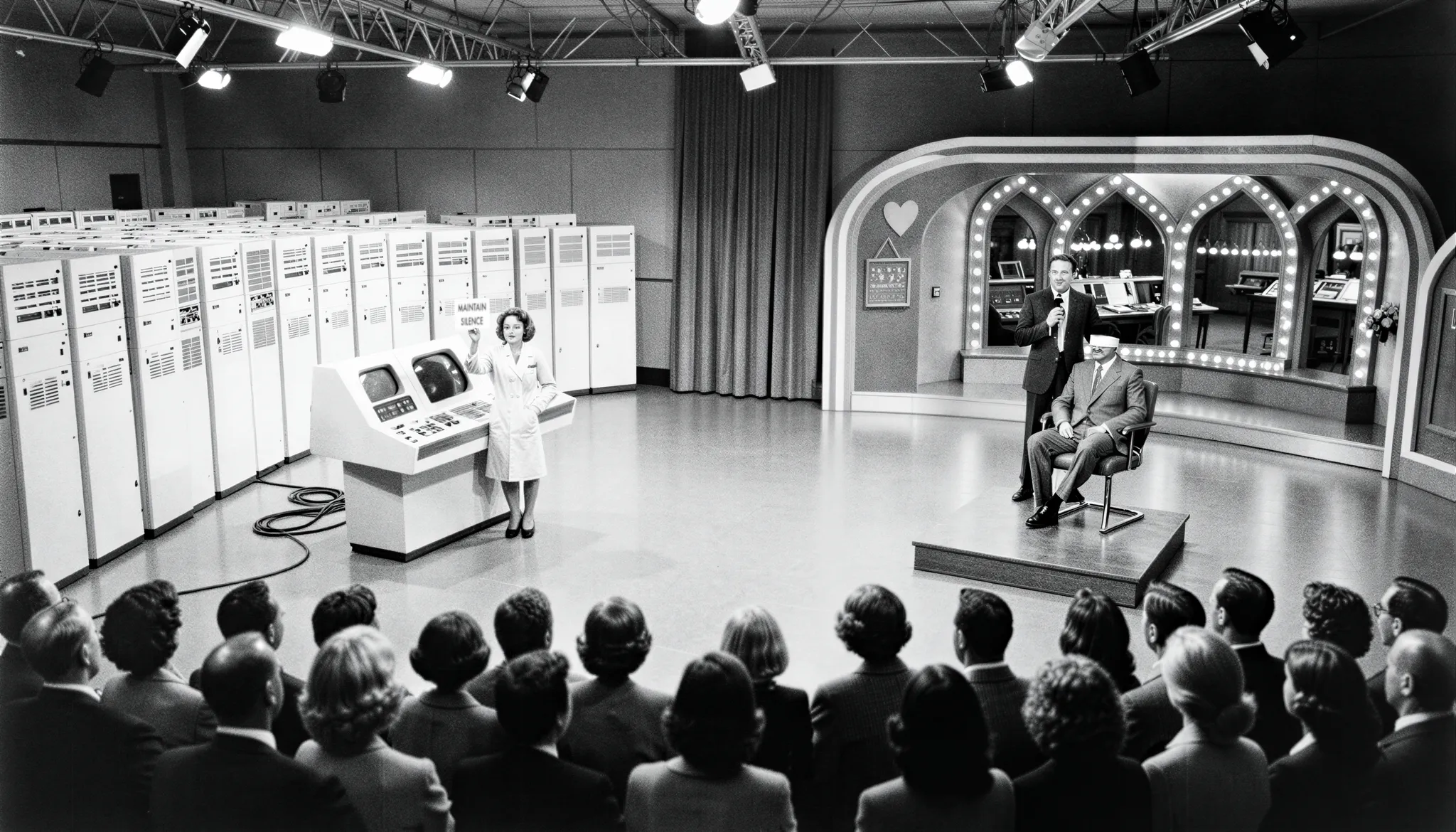
To generate the three imaginary photographs in this piece, I used a local AI model (Flux2) on a PC powered by solar panels. This allowed me to iterate dozens of times until I had what I wanted, while keeping the environmental footprint of the process as small as I could.
History of computing
- An excellent book on the history of computing: The Innovators by Walter Isaacson https://www.simonandschuster.com/books/The-Innovators/Walter-Isaacson/9781476708706
- Ada Lovelace (analytical machine, 1842) https://en.wikipedia.org/wiki/Ada_Lovelace
- Alan Turing, Computing Machinery and Intelligence (1950) https://www.csee.umbc.edu/courses/471/papers/turing.pdf
AI today
- ChatGPT broke the Turing test — the race is on for new ways to assess AI (25 July 2023) — Celeste Biever — Nature https://www.nature.com/articles/d41586-023-02361-7
- Jones, Cameron R.; Bergen, Benjamin K. (31 March 2025). “Large Language Models Pass the Turing Test” https://arxiv.org/abs/2503.23674
- Exploring the Dangers of AI in Mental Health Care — Sarah Wells (June 11, 2025) https://hai.stanford.edu/news/exploring-the-dangers-of-ai-in-mental-health-care
ELIZA — a natural language processing computer program
- ELIZA https://en.wikipedia.org/wiki/ELIZA
- A site compiling many resources on ELIZA, with links to various versions of the source code https://sites.google.com/view/elizagen-org/try-eliza?authuser=0
- A version of ELIZA to try online: https://anthay.github.io/eliza.html
- IBM System/360 (memory, historical context) https://en.wikipedia.org/wiki/IBM_7090
- ELIZA effect — the tendency to attribute comprehension to a machine https://en.wikipedia.org/wiki/ELIZA_effect
Eliza — The video game
- Eliza (Zachtronics, 2019) https://store.steampowered.com/app/716500/Eliza/
Humans and machines in culture
- Jonathan Swift, Gulliver’s Travels (1726) https://en.wikipedia.org/wiki/Gulliver%27s_Travels
- The Pygmalion myth https://en.wikipedia.org/wiki/Pygmalion_(mythology
- Eliza Doolittle — protagonist of George Bernard Shaw’s play Pygmalion (1913) https://en.wikipedia.org/wiki/Eliza_Doolittle